
Laguna 69 Hike in Peru: A Complete Guide for 2025
If you’re planning a trip to Huaraz, there’s no doubt that you’ve already heard of Laguna 69.
The Laguna 69 hike is the most popular you can do in the Cordillera Blanca mountain range. This isn’t surprising as it’s one of the most scenic hikes we’ve ever done, ending with the bluest lake we’ve ever seen! There’s no wonder it ends up on so many peoples bucket lists.
Thanks to becoming a viral sensation on instagram, Laguna 69 has become an iconic destination to visit in Peru. This means that during the high season between May and September, this place is bustling with people.
The thought of this would usually put us off such a hike, but we decided to see what the buzz was about and do it anyway. And we didn’t regret it!
Though there are many other beautiful hikes you can do in the Cordillera Blanca to get off the beaten track and avoid these crowds, we still really recommend visiting Laguna 69 as well.
In our opinion, no trip to Huaraz is complete until you’ve seen Laguna 69. Sure, you won’t get these views to yourself, but in our experience it didn’t hinder our enjoyment or ruin the natural beauty surrounding us. If you just set your expectations right, it might end up being one of your favourite hikes in Peru too.
However, many people come here for those famous insta snaps, not realising that the hike up to Laguna 69 is no walk in the park. This is, in actual fact, a serious hike and one that requires some preparation as it reaches altitudes of 4,600 m.
Though it’s absolutely doable for people with varying levels of fitness, this isn’t a short walk that can be done in jeans and trainers. You need to be prepared properly for this hike with the correct gear and ensure that you acclimate to the altitude in the few days prior.
If you’re not sure what to expect from the Laguna 69 hike, we’re here to help. We’ll walk you through the difficulty of the trek and break down each different section so that you fully know what you’re walking (or hiking) into. Alongside this, we’ll get you prepared with a packing list and give you alternative options on how to get there with and without a tour.

Is the Laguna 69 hike difficult?
The Laguna 69 hike is a moderate to difficult hike, depending on how acclimated you are to the altitude.
Though it’s not the longest hike (just 12 km return), there is an altitude gain of over 800 m. As the trailhead already sits at 3,800 m above sea level, this means you have to hike up to 4,600 m which can leave even the fittest individuals struggling to catch their breath. However, if you spend a few days acclimatising and doing some shorter hikes in the area, you’ll find this hike much easier and more enjoyable.
The Laguna 69 hike is an ‘in and out’ trail, meaning that you’ll trek up to the lake, enjoy the views, and then take the same route back down.
The hike to Laguna 69 usually takes around 3 hours. You’ll then want to spend around 30-60 minutes relaxing and admiring the views, before trekking back down. The walk back usually takes less than 2 hours. Therefore, it’s likely that it will take you around 6 hours in total.

Preparing for the altitude
Okay, we know we’ve mentioned this so many times already but preparing for the altitude really is important. It might be tempting to head straight to Laguna 69, especially if you are short on time, but we’d really advise against this to avoid altitude sickness.
Altitude sickness typically occurs when you ascend to high altitudes too quickly and your body struggles to adapt to the reduced oxygen levels. Symptoms of altitude sickness include a headache, nausea and vomiting, dizziness, fatigue and shortness of breath.
The best way to avoid this is to increase your altitude slowly in order to acclimatise. Basically, don’t start with a trek like Laguna 69!
If you’re coming from sea level we recommend spending a few days in Huaraz acclimating first. Huaraz sits at 3,052 m above sea level so spending just a few nights here can help a great deal. Some good day trips to do from Huaraz while acclimating are Laguna Wilcacocha or the Monterrey Hot Springs.
Whilst on the trek, it’s important to make sure that you stay hydrated and take it slowly. You may even want to take some altitude sickness medication just in case. If you follow all of these steps you’ll have a much more enjoyable hike and avoid ruining your trip with altitude sickness.

Where to base yourself for the Laguna 69 hike: Caraz vs Huaraz
When planning your visit to Huascaran National Park, there are two main locations to consider as a base to hike from. We’re sure you’ve already heard of Huaraz but there is also the option of staying in Caraz.
Huaraz is the larger and more popular of the two, acting as the main tourist hub in the area. This means you’ll find more options in the way of hotels, tours and restaurants. As we mentioned above, it also sits at over 3,000 m which means it’s the perfect place to spend a few nights to acclimate.
If you are likely to take a tour to Laguna 69 and you prefer to stay in places with more tourist infrastructure, this is the most convenient place to stay.
However, if you want to visit Laguna 69 independently, you may want to stay in the smaller, quieter town of Caraz. Caraz sits 45 km closer to the trailhead, meaning that you can spend less time travelling and more time at Laguna 69 itself.
If you choose this option, we’d still recommend staying in Huaraz for a few nights prior to do some day trips from there and acclimate to the altitude.
Caraz is less touristy than Huaraz but in our opinion it’s much nicer and there are still some great accommodation and restaurant options. As we took public transport to the trailhead and did the hike independently, this is the option that we chose.
Laguna 69 Entrance Fee
Laguna 69 sits within the Huascaran National Park, meaning that you must pay the national park fee to enter.
There are a few different ticket options to choose from. If Laguna 69 will be your only hike within the national park, you can purchase the one day permit which costs S/30 ($8).
However, there are so many other hikes that you can do within the national park, including Laguna Churup and Laguna 513. If you plan to stick around and do some more trekking you can also buy multi day passes. A three day pass costs S/60 ($16) or you can get a ticket for a full month which costs S/150 ($40).
Make sure to plan which treks you will do in advance. This way you won’t end up having to pay for multiple one day passes.

How to get to Laguna 69
There are multiple ways to get to Laguna 69 both with and without a tour. Below we’ll go through the various options and the costs so that you have all the information to choose the one that fits best with your budget and travel style.
Laguna 69 Tour
The most popular way to get to the Laguna 69 trailhead is by tour from Huaraz. However, this is less a tour and more just organised transport as you don’t usually get a guide or any meals included.
The tours typically pick you up from your accommodation between 4:30-5am to begin the 3-4 hour drive to the trailhead. Along the way, you will stop for some breakfast (which isn’t usually included in the price) and at Laguna Llanganuco to take some pictures.
You’ll arrive at the trailhead between 9-10am and you are given 6 hours to complete the trail as you must make it back to the bus by 3pm to return to Huaraz.
Tours to Laguna 69 are pretty budget friendly, costing between S/40 ($11) to S/55 ($15). However this doesn’t include the S/30 ($8) entrance fee.
If you decide to stay in the closer town of Caraz, there are daily tours from here too. The itinerary looks very similar but the drive is around 1 hour shorter, meaning you won’t have to spend as much time on the bus.
It is possible to book a tour to Laguna 69 in advance. However, to get the best price it’s better to shop around in Huaraz or Caraz as there are so many companies that offer these tours daily, making the prices very competitive.

Getting to Laguna 69 without a tour
Getting to Laguna 69 with Public Transport
If you are like us and want to visit Laguna 69 independently, you can take public transport all the way to the trailhead.
If you decide to do the trek without a tour, we recommend staying in Caraz because it’s much closer to the trailhead.
From Caraz, you need to take a bus from the ‘Huaraz’ Terminal to Yungay. The first one leaves at 5am and takes around 30 minutes, costing S/2 ($0.50) per person.
From here you need to take another bus or colectivo to La Cebolla, which is where the hike begins. The colectivos leave once full which means you may spend a bit of time waiting around before you get going. This costs S/20 ($5.50) per person.
If you are travelling independently from Huaraz, the journey is similar but you have to catch a bus from Simon Bolivar to Yungay which takes around 1.5 hours and costs S/5 ($1.30). The first one leaves at 5.30am.
To return to Caraz or Huaraz, you can wait at the main road where you were dropped off and flag down a passing colectivo to go back to Yungay. The last one usually passes between 3pm and 4pm. Once in Yungay, you can catch one of the colectivos that leave regularly back to either Caraz or Huaraz.
We decided not to wait and instead hitched a ride with one of the tour buses that had empty seats. This took us to Yungay but you could get lucky and catch one all the way back to Caraz or Huaraz (though this is never guaranteed).
In total, to travel to and from Laguna 69 on public transport, it costs around S/44 ($12) return from Caraz or S/50 ($13.50) return from Huaraz without the entrance fee.
This means it’s not cheaper than taking a tour. Despite this, there are still a number of reasons why we preferred visiting Laguna 69 independently.
The first reason is that we were able to arrive a bit earlier than the tour buses. This didn’t mean we got the lake to ourselves (like with Laguna Paron), but it did mean that we were one of the first on the trail when it was less busy.
The second was that it meant we could take our time on the hike and set our own pace.
As we arrived at the trailhead early, we were able to spend as much time as we liked enjoying the views once we reached Laguna 69, without having to rush down to catch the last bus. We also didn’t have to wait for people if they were slower than us, or hold people up if they were faster.
However, it’s much more convenient to have your transport organised for you on a tour and you don’t have to worry about getting transport back.
Laguna 69 by Taxi
If you really want to visit Laguna 69 independently but don’t want to take public transport, a more convenient but more expensive option is to take a taxi.
Taxis can be arranged from either Huaraz or Caraz and costs around S/150 to S/180 ($40-$48) for a return trip. This sounds expensive but if you have a group of people to share the cost it can end up being around the same price as a tour or public transport.
It’s best to arrange this the night before the hike so that you can agree on a time and arrive at the trailhead before the tours start to come in. A good way to do this is to ask your accommodation provider to organise the taxi for you as they usually have good contacts.
What to expect on the Laguna 69 Hike
Now for the exciting part, the hike!
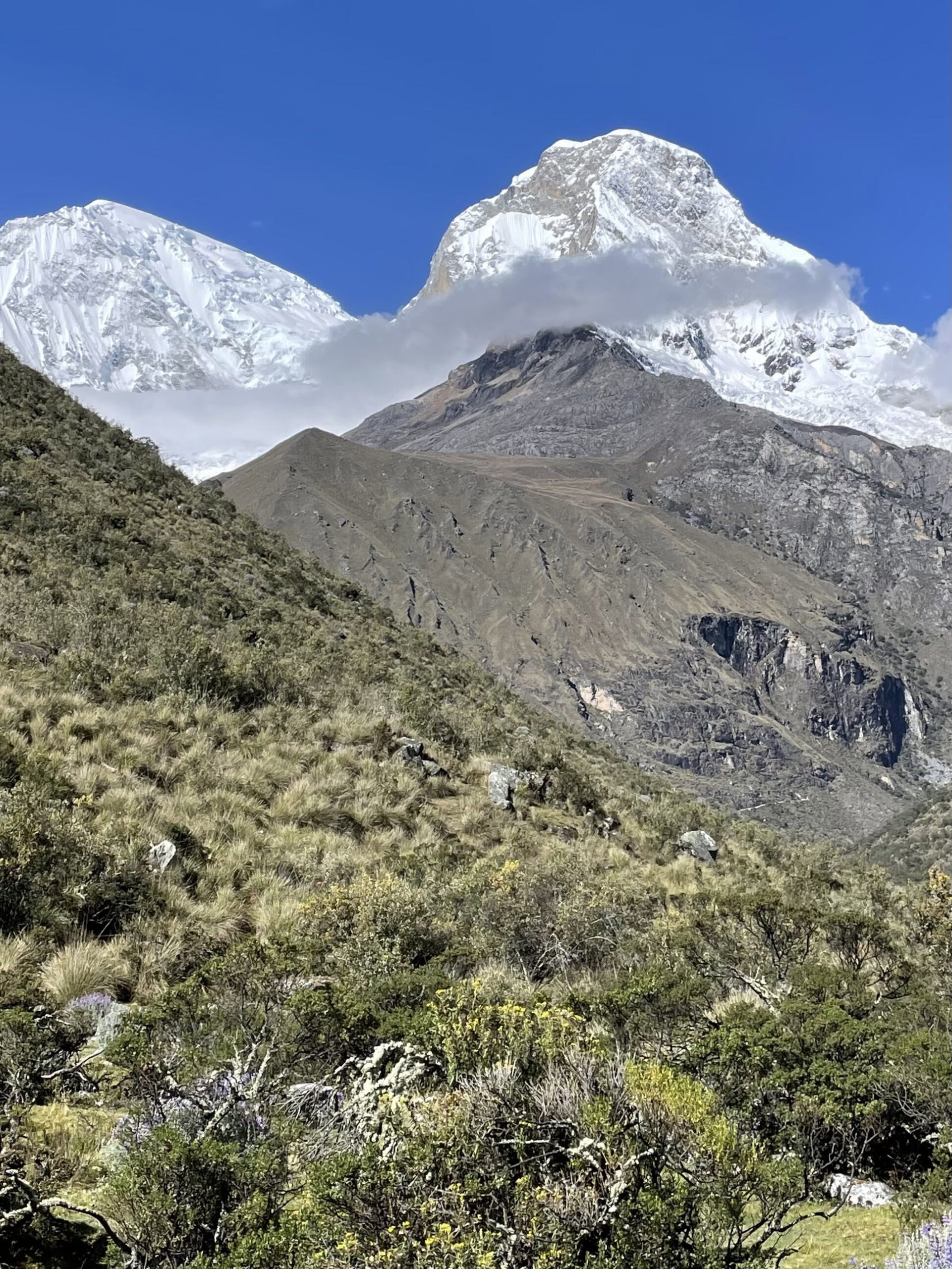
The hike starts off within a beautiful valley between two giant snow-capped mountains. For the first kilometre the trail is relatively flat and easy, weaving alongside a river and through a meadow.


After this, it starts to get a little more difficult as you reach the first set of switchbacks. These never ending switchbacks turn what would be a very steep ascent, into more manageable stretches of gradual incline.
As you begin to get higher, the views become even more impressive, with the snow-capped mountains getting closer and stunning waterfalls trickling down into the valley. Although we were starting to get a bit breathless at this point, the views definitely took our minds off it.


At the end of the first section of switchbacks, you’ll reach a small lagoon named Laguna Esperanza. Here you’ll see a sign telling you that there is only 1 more hour to go! We recommend stopping for a short breather and a snack.


After a quick break and a pleasant walk through a grassy meadow, you’ll find yourself at the second, and steeper (but shorter) set of switchbacks.
The terrain begins to get a little uneven here which is why it’s important that you come prepared with some good, ankle supporting hiking boots. You may also want to bring some hiking poles to help you out (though we managed without them).
The final kilometre is definitely the most difficult section of the trek. At this point you’re reaching pretty high altitudes and the air begins to get thinner. This isn’t helped by the fact that the path becomes even more steep.


As you near the top, you’ll finally get your first glimpse of Laguna 69 and forget all the pain. Even though we’d seen so many photos of this place, it still didn’t fail to surprise us with how beautiful it was. It was even better in real life. The lake was the most incredible shade of blue and the snow-capped mountains in the background made it even more breathtaking.
The hike to the top took us around 2.5 hours but it can take anywhere between 2-3 hours depending on your speed.
When we arrived there weren’t too many people at the top so we took advantage of this and took some snaps. Afterwards we found a nice spot to sit and eat some lunch while enjoying the view.
It’s also possible to swim here but we weren’t brave enough to jump into the freezing cold water. However, we can imagine it would be quite refreshing.
If you’re on a tour, you’ll only have around 30 minutes at the top, so make sure to make it count.
The hike back down follows the same route as the way up but unsurprisingly it’s much easier. You’ll reach the bottom in less than 2 hours and you can spend more time admiring the views rather than focusing on being able to breathe.

What to pack for Laguna 69
To ensure that you have an enjoyable hike, it’s important that you come prepared and bring the correct gear. Here is what we recommend to bring:
- A comfortable daypack: Make sure that your backpack sits comfortably on your back. Preferably it will be a backpack made specifically for hiking that has a waist or chest strap to help distribute the weight better.
- Plenty of layers – When you are hiking up to high altitudes in the mountains, the weather can be very temperamental. Make sure to layer up so that you can regulate your temperature.
- Waterproof jacket – Even if you are visiting in the dry season and it looks clear when you leave for the day, there is always a chance that it can rain.
- A good pair of hiking boots – Wear hiking boots with good ankle support as the terrain can get very uneven.
- Lots of water – To stay hydrated you need to bring enough water. We like to use a water bladder so that we can carry more water and take easy, regular sips.
- Sunscreen – As you are close to the equator and at a high altitude, the sun is very strong even in the winter so don’t forget to pack sunscreen.
- A phone and portable charger – This is particularly important if you are hiking without a tour. This way you can always have a charged phone to contact someone in case of an emergency. On a tour, you may need this for entertainment on the long journeys.
- Camera gear – If you have camera gear, you’ll want to take it to capture this stunning lake.
- Trekking poles – If you struggle with issues with your knees, taking trekking poles is a good idea. If you don’t have your own, you can rent them in Huaraz.
- Lunch and snacks – Whether you are hiking on a tour or independently, you need to take your own food (as meals aren’t included in the tours). Make sure to take plenty to keep your energy up.
For a full packing list for Peru, you can read more here.

The best time to visit Laguna 69
The best time to visit Laguna 69 is in Peru’s dry season from May to September. Visiting in this season will mean that you can avoid the rain and experience the best hiking conditions.
During this time, the days are usually clear and sunny which means you’ll get to experience the best views of the mountains and observe Laguna 69 at its brightest and most beautiful.
However, make sure to layer up and bring some warm clothes as this is also winter in Peru, meaning temperatures can drop below zero once the sun goes down.
How to get to Caraz and Huaraz
From Lima
There is no airport in Huaraz, so the only way to get there from Lima is by bus. As it takes 8-9 hours, the most popular option is to take a night bus.
Movil, Civa and Cruz del Sur are a few of the bus companies that offer this route, but the best way to check routes or book your ticket is on BusBud.
If you want to visit Caraz first, you can take a colectivo here directly from Huaraz. The station is named ‘Paradero Caraz’ on google maps. However, some night buses do continue on to Caraz so make sure to check this with your bus company.
Bus tickets range between S/75 and S/114 ($20-$30) depending on the company, the time and which seat you choose.
From the Coast
If you are somewhere along the northern coastline of Peru, Caraz or Huaraz is a logical next stop. It’s best to travel to Huaraz on a night bus from the city of Trujillo. This takes 8-9 hours and costs around S/55-S/65 ($15-$17). Linea is the main bus company that runs this route.
All buses to Huaraz will pass Caraz so you can get off here on the way. This will take 1.5 hours off your journey.
RedBus is the best website to search for booking this route.
From Cajamarca
We travelled to Caraz from Cajamarca. This is a little more complicated than one night bus but is still an easy route. From Cajamarca, take the night bus to Trujillo or Chimbote. Many of the routes and times between Cajamarca and the coast do not show up online. Therefore it’s best to book your ticket in person at Terminal Terrestre in Cajamarca.
Once in Trujillo or Chimbote, take a direct bus to Huaraz or Caraz.
Where to stay in Caraz
Low Budget: La Plaza Hospedaje – This is a basic but clean and comfortable guesthouse that is located in the perfect location overlooking the Plaza de Armas. It has its own restaurant and offers free wifi and a 24 hour front desk. Prices range from S/68 to S/93 ($18-$25).
Mid Range: Hotel Dulzura – This is a comfortable hotel located close to the Plaza de Armas. It has a restaurant, bar, garden and shared lounge. It also has it’s own tour desk and free wifi. This costs between S/90 and S/223 ($24-$59).
High Budget: Casa Pukayaku Lodge – This is a highly rated lodge located just outside of Caraz. It has spectacular mountain views as well as it’s own restaurant, a shared lounge, bar, garden, outdoor pool and terrace. It offers free breakfast and free wifi to all guests. This is a more luxurious stay costing S/290 ($77) per night.
Where to stay in Huaraz
Low Budget: Krusty Hostel B&B – This is a basic but comfortable hostel that offers both private rooms and dorm rooms, free wifi and complimentary breakfast. Prices range from S/40 to S/130 ($11-$34).
Mid-Range: Selina Huaraz – Selina is a modern hostel that offers both private rooms and shared dorms. It has its own restaurant, bar, a shared lounge and garden, as well as free wifi. Breakfast is included in the price of some rooms but you may have to pay extra. The price ranges from S/50 to S/400 ($13-$105).
High Budget: The Lazy Dog Inn Mountain Lodge – This is a cosy mountain stay with delicious free breakfast and stunning views. It’s a little outside of Huaraz but offers a peaceful, more luxurious stay. Prices start from S/590 ($160).
Final Thoughts on hiking Laguna 69
Whether you decide to visit Laguna 69 with or without a tour, there is no doubt that it will become one of your favourite hikes in Peru.
Though it’s no walk in the park, this hike is definitely doable for people with varying fitness levels. As long as you come prepared with the correct gear and spend some time acclimating to the altitude, you’ll find Laguna 69 thoroughly enjoyable.
We hope that this guide has made it easier to plan your trip to Laguna 69. As always, if there are any questions we haven’t answered feel free to send us an email, we’re always happy to help!
Please note that some links on our blog are affiliate links.
If you decide to purchase anything through our affiliate links, it may make us a small commission with no extra cost to yourself. This helps to support us and allows us to keep writing our travel blog to bring you free tips, guides, and recommendations. As always, we thank you for your continued support and for joining us on this journey.
Happy Travels!


