
12 Best Things to do in Lima, Peru
If you’re planning a trip to Peru, you have to make sure its vibrant capital is on your itinerary. Lima is up there with our favourite cities in South America due to its lively and colourful neighbourhoods, rich history, rugged coastline and world class cuisine.
There are endless things to do in Lima. From strolling along the cliff sides between the laid back neighbourhoods of Miraflores and Barranco, to surfing or paragliding over its long stretch of beaches. From learning about the history in interesting museums, to visiting ancient pyramids. From drinking Pisco Sours with coastal views, to finishing off the day in a world-renowned restaurant, you’ll never be bored here.
Sometimes when there’s so much to do in one city it can be overwhelming trying to plan your stay, especially if you have limited time.
That’s why we’ve put together this detailed guide of the 12 best things to do in Lima, so that you can do less planning and research, and more exploring. Whether you’re a history buff, beach lover, adrenaline junkie or serious foodie, there’s something for everyone in this guide to Lima.

What to do in Lima, Peru: 12 things you can’t miss
1. Take a walking tour
When you first arrive in Lima we highly recommend joining a free walking tour.
This way you can learn about the history and culture of the city, and get some useful recommendations from a local on what to do, where to eat and so on. It also allows you to get to know Lima and its streets a bit better so that you can easily navigate it yourself.
There are a few different neighbourhoods where you can join walking tours in Lima. The most popular are the Historic Centre (or Downtown Lima), Miraflores and Barranco.
Though many companies and hostels often offer free walking tours, we recommend going with the official ‘Lima Walking Tours’ which leave daily from both Tourist Information Centers in Miraflores (Av. Jose Larco 799 / Kennedy Park). You can find the departure times for all of the walking tours here.
However, it’s important to note that ‘free’ walking tours aren’t really free. In most cases they are tip based so you’ll need to pay what you think it was worth at the end of the tour. Please remember that this is how the guides make a living, so make sure to pay them fairly.


2. Stroll the Malecón Scenic walkway, visiting El Parque Del Amor
The Malecón is a picturesque walkway along the upper edge of the Costa Verde cliff in Miraflores. It stretches 8 km and connects several beautiful parks that provide some of Lima’s best ocean views.
Along the way you’ll find a number of tourist hotspots such as the Larcomar Shopping Centre and the Parque Del Amor.
Translating to ‘The Park of Love’, El Parque Del Amor was opened on Valentines Day back in 1993. It’s a colourful park, made up of curving mosaic-decorated benches and blooming flower beds, surrounding the famous ‘El Beso’ (The Kiss) statue. It actually really reminds us of the Parc Güell in Barcelona.
Just a 15 minute walk into Miraflores from Parque Del Amor, you’ll find another well-known park named Parque Kennedy. This park is popular for a unique reason, which is its large population of stray cats. These well looked after cats were once brought in to fix a rodent problem but have now bred in large numbers, creating their own tourist hot spot.
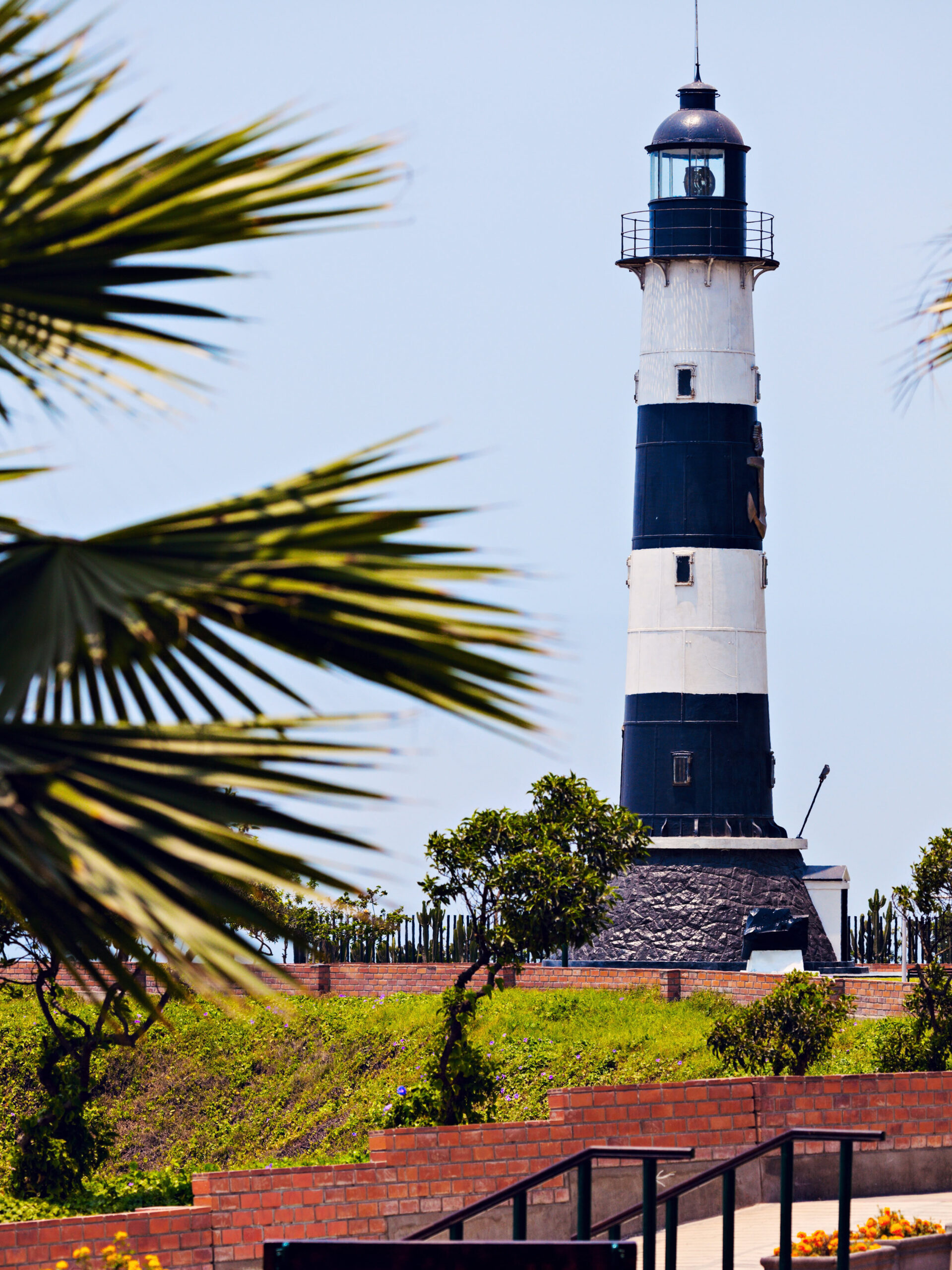
Another notable place to stop is at the Miraflores Lighthouse (Faro la Marina). This is just 10 minutes from Parque Del Armor.
One of the best ways to enjoy the Malecón walkway and visit these spots is by bike. This flat, spacious walkway makes for the perfect tranquil and scenic cycle. There are many places where you can rent bikes in Miraflores or you can sign up to public bike sharing service CityBikeLima and pick up one of their bikes that are dotted around the city, returning them at any free dock. You can find out how it works and prices here.
Another option is to take a stroll here at sunset and find a nice bench that looks over the coastline to watch the sun go down. Alternatively, head to a sea-front bar and treat yourself to a Pisco Sour.


3. Admire the street art in Barranco
As you walk along the Malecón, you’ll eventually reach our favourite neighbourhood in Lima, Barranco.
The streets of Barranco are filled with street art and murals that bring so much colour and life to the city. It’s almost like an outdoor art gallery!
You’ll also find leafy green parks, beautiful colonial architecture, and the traditional wooden bridge of Puente de los Suspiros. This famous bridge is known to be a romantic spot where couples who are in love meet.
We recommend wandering the streets yourself or taking a free walking tour (or bike tour) to learn a bit more about the neighbourhood.

4. Hike up to Morro Solar
After visiting Barranco, we recommend continuing to the district of Chorrillos to visit the best lookout point in Lima.
As you walk along the coastline in Miraflores, you might notice a large cross as well as a statue resembling Rio de Janeiro’s ‘Christ the Redeemer’ standing on top of a hill to the south. This hill is commonly known as the Morro Solar.
To get there, you can take a public bus or taxi from Barranco or Miraflores to Chorrillos. Taxis usually cost between S/15 ($4) and S/20 ($5.50) each way.
From here, you can hike up to the viewpoint at the top of the hill and enjoy unbeaten views across Lima.
You will also find a Planetarium at the top of the hill which is definitely worth a visit on a clear night.

5. Paraglide above the city
If you want even better views over Lima and are looking for an adrenaline rush, paragliding is a popular activity to do in the Miraflores neighbourhood.
You’ll spend 10-12 minutes soaring over the cliffs of the Costa Verde, taking in spectacular views of the pacific coastline and Lima itself.
We recommend booking with a reputable company that has experienced, licensed guides. There are a few that operate in Miraflores so you can compare them and book once you arrive or book online in advance here.
Tours typically cost around S/285 ($75) per person and include unedited HD footage of your entire flight.

6. Go surfing
After admiring the beautiful coastline from above, one of the best things to do in Lima is to head down to the beaches and go surfing.
Surprisingly, Lima has some great waves for surfers. The best time to surf here is between December and February when the ocean temperatures are at their warmest. However, you’ll find people making the most of the waves here all year round.
One of the most popular surf points in Lima is La Herradura. Here there are a mixture of small waves and huge ones that reach up to 12 ft tall.
If you’re a beginner wanting to learn to surf, Cerro Azul is the best beach to head to.
You’ll find many places in Miraflores to book surfing lessons or to rent surfboards and wetsuits.

7. Visit Lima’s Historic Centre
If you’re interested in the history of Lima and want to visit the most significant landmarks and buildings, you have to head to the historic centre.
Here you can visit Lima’s oldest public space, the Plaza Mayor (also known as the Plaza de Armas). This is considered as the centre of the city and has many important buildings situated around it, including the main Cathedral, the Governmental Palace and the Municipal Palace.
This part of the city also provides some of the most beautiful architecture in Lima.
To fully appreciate and learn about Lima’s historic centre, we really recommend taking a walking tour here.

8. Visit the catacombs at the Saint Francis Monastery
Whilst in the historic centre, we recommend making a stop at the bright yellow Basilica y Convento de San Francisco.
This monastery and church has some impressive grounds that are most famous for their bone-lined catacombs. These catacombs were used until the early 19th century as a cemetery and contain thousands of remains.
Another significant site to visit in the monastery is the historic library that holds around 25,000 ancient texts, some of which date back before colonial rule.
We recommend visiting here when it opens at 9 am to avoid the crowds. Entrance to the church is free, but if you want to continue into the monastery and catacombs you have to pay a fee of S/15 ($4).

9. View ancient artefacts at the Larco Museum
If you’re looking to learn even more about Peru’s history, you may want to visit the Larco Museum.
Peru has a variety of unique civilisations across the Andes and within its dense jungle. The Larco Museum displays rare artefacts, some over 5000 years old, that once belonged to Cupisnique, Chimú, Chancay, Nazca, and Inca cultures.
The museum is open every day between 10 am and 7 pm and is located in the district of Pueblo Libre. The entrance fee costs S/50 ($14) per person.

10. Visit Huaca Pucllana – The Pyramid of Lima
If Peru is known for one thing, it’s its impressive ancient ruins. Of course the most popular is Machu Picchu, but you can also visit some ancient pyramids in Lima.
Huaca Pucllana is an adobe and clay pyramid with staggered platforms, built by the Lima Civilisation in around 500 A.D.
Archeologists believe that it was a home for the elite, as an excavation here revealed numerous tombs with mummies inside that depicted great wealth.
This archeological site is located within the Miraflores district and is open between 9 am and 4.15 pm from Wednesday to Monday (closed on Tuesdays). To enter it costs S/15 ($4) per person.
From Wednesday to Sunday, they also have evening opening hours between 7 pm and 10 pm. To enter at this time it costs S/17 ($4.50) per person.

11. Make a reservation at one of Lima’s top restaurants
Peru is well-known for having some of the best food in the world and the best place to try it is in Lima.
Lima is home to 3 of the top 50 restaurants in the entire world, so if you are a fellow foodie you can’t miss out on dining here.
The best restaurant in Lima is named Maido. This has been named the best restaurant in South America 2024 and the third best in the world! This is a Peruvian and Japanese fusion restaurant located in the Miraflores district. Here you can enjoy an incredible 10 course tasting menu, paired with a delicious cocktail or some wine.
Another restaurant that makes it into the top 50 in the world is Kjolle. Restaurant owner and Head Chef Pía León is said to be one of the world’s top female chefs. Here you can try delicious and innovative Peruvian cuisine. You can find this restaurant in Barranco.
Lima’s third best restaurant is called Mayta. Located in Miraflores, Mayta specialises in Peruvian cuisine and cocktails. One of their most popular dishes is their Amazonian ceviche.
Some other top restaurants to dine at in Lima include Astrid y Gastón, Carnaval Bar and Central, but you can find the full list here. If you want to dine at any of these restaurants, we recommend booking in advance.


12. Watch the light show at Circuito Magico del Agua
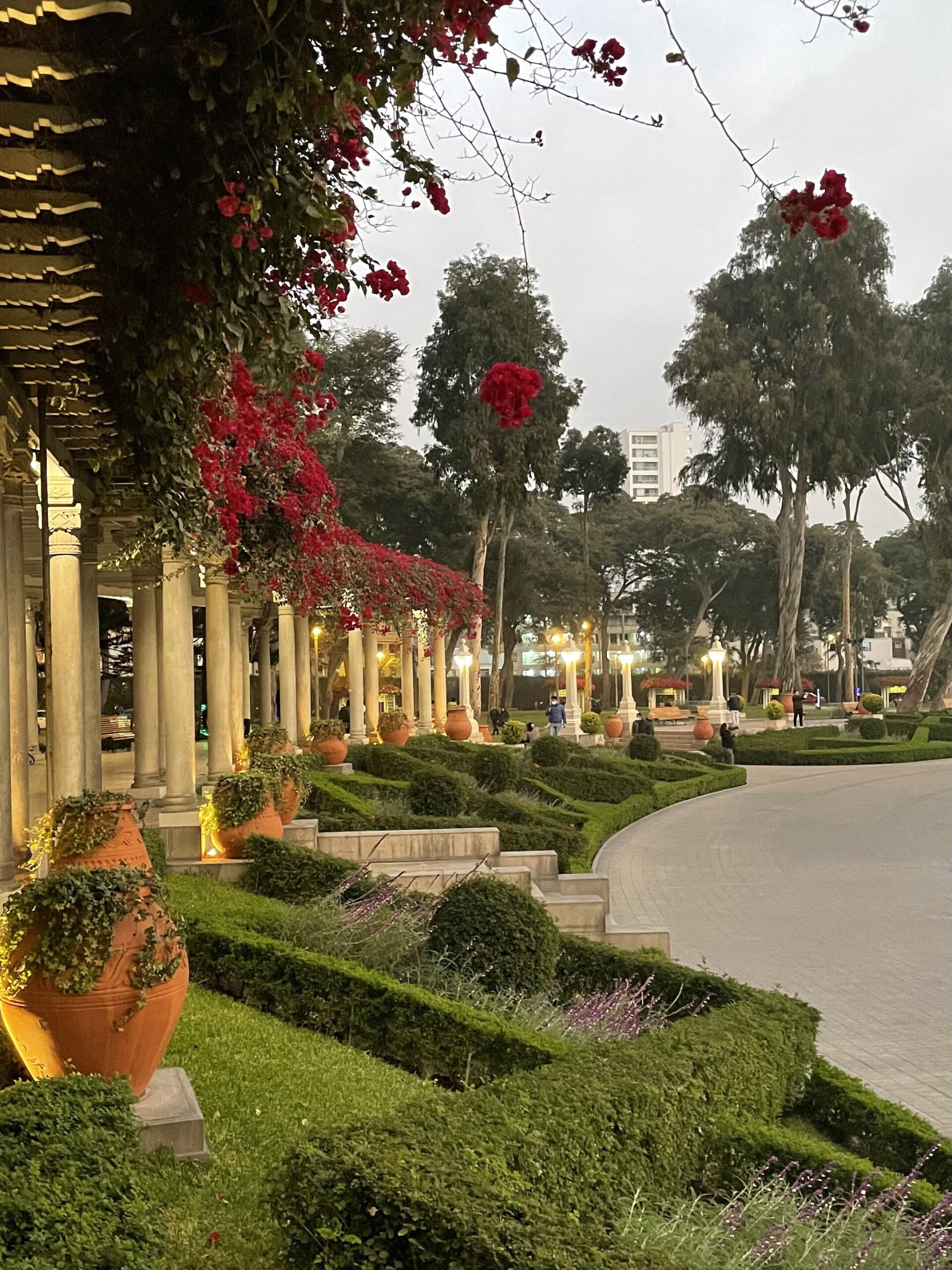
Last, but definitely not least, we recommend spending an evening watching the water fountain light show at Circuito Magico del Agua. This is one of our favourite things to do in Lima.
Found within the Park of the Reserve are more than 13 water fountains that are used to put on an impressive show. If you arrive at around 7 pm you’ll be able to witness this spectacular event which projects videos onto the fountains and uses coordinated music to tell stories of Peru’s history and depict local culture.
There are 3 shows every evening which begin at 7:15 pm, 8:15 pm and 9:30 pm. Admission costs just S/5 ($1.50) per person.
Best time to visit Lima
The best time to visit Lima is between November and March to enjoy warmer temperatures and sunny days.
This is Peru’s summer but also the wet season. Though it doesn’t rain often during these months in Lima, if you are planning to head into the Andes and visit destinations such as Cusco and Machu Picchu, the best time to visit Lima doesn’t coincide with the best time to visit the rest of Peru.
If you visit in the dry season between May and September, you’ll still get pleasant (though slightly colder) weather in Lima, but the weather will be perfect for hiking and visiting the majority of Peru’s popular sites.
To avoid the crowds and enjoy the dry season when the temperatures have not yet dropped too low, the perfect time to visit is in May.

How many days do you need to see Lima?
How much time you spend in Lima really depends on how much you want to see and do. We recommend spending at least 2-3 days here to see the highlights. Make sure not to miss the neighbourhoods of Barranco, Miraflores and the Historical Centre.
Where to stay in Lima
We recommend staying in one of the safe, beautiful and walkable neighbourhoods of Miraflores or Barranco.
Low Budget Option: Alpes Lima Kennedy Park Hostel – This is a lovely, social hostel located in Miraflores. It has a small pool and rooftop bar, fitness centre, garden, shared kitchen, shared lounge and free wifi. It has both shared dorms and private rooms with prices ranging from S/45 to S/230 ($12-$60).
Mid-Range Option: 18th Floor Ocean View Apartment – There are so many amazing and reasonably priced Airbnbs in Lima. This one is a private apartment in Barranco with a shared rooftop pool and hot tub. This costs S/200 ($55) per night.
High-Budget Option: INNSiDE by Meliá Lima Miraflores – This is a beautiful luxury hotel in Miraflores with a rooftop swimming pool and free breakfast. Prices here start at S/580 ($155) per night.
How to get to Lima
The easiest way to get to Lima is to fly into the Jorge Chavez International Airport. This is a large international airport so many major airlines will fly here.
Getting to Lima from Jorge Chavez International Airport
To get into the city from the airport you can either take a taxi or airport shuttle.
By Taxi
If you decide to take a taxi, make sure that you get into a registered, marked taxi. Some companies that we recommend are Taxi Green, Taxi 365, or Taxi Directo.
It’s not possible to order an Uber at the airport as they are not allowed to enter.
If you are staying in the popular district of Miraflores (which we recommend), a taxi will take around 35 minutes and should cost no more than S/50 ($14). Make sure to confirm the price with your driver before you get in the car as otherwise you may be charged a premium.
By Airport Express
This express shuttle costs S/20 ($6) to and from the airport to Miraflores. This shuttle has 7 bus stops within the Miraflores district where it stops for passengers to get on and off.
Tickets can be purchased from within the airport, online or you can pay the driver directly.
Getting to Lima by Land
If you are travelling from a bordering country such as Ecuador, Bolivia or Chile, you may decide to travel to Lima by bus. For all border crossings into Peru, you can find the logistics here.
Getting around Lima
Once you’re in Lima, there are a few ways to get around.
By Foot – If you are staying in Miraflores or Barranco, many of the main sights are easily accessible by foot. This way you also get to see as much as possible.
By Bike – If you don’t enjoy walking and would rather cycle, Lima is a lovely city to explore by bike. With this option you can cover more distance to see more in less time. There are many places where you can rent bikes in Miraflores or you can sign up to public bike sharing service CityBikeLima and pick up one of their bikes that are dotted around the city, returning them at any free dock. You can find out how it works and prices here.
By Bus – To get to sights that are further away, you can travel by bus. The cheapest form of public transport are the shared vans named ‘combis’ that you’ll see whizzing around the city with a person shouting the destination from the door. You can get pretty much anywhere in one of these but be prepared for the full local experience. You won’t get much comfort here.
If you are heading to the Historic Centre, the best option is to take the express ‘Metropolitano’ bus. This costs just S/2.50 ($0.50) each way.
Taxi – If you’d rather not travel on public transport you can take a taxi. We don’t recommend using Uber here but you can use alternative taxi apps including Easy Taxi or Cabify.


Final Thoughts: Best Things to do in Lima, Peru
I hope that through this guide we have convinced you to stop for at least 2-3 days in Peru’s capital. There are countless things to do in Lima. Whether you are someone who enjoys roaming colourful neighbourhoods, learning about history, eating delicious food, or hitting the waves at the beach, there is something for you to do here.
As always, if there are any questions we haven’t answered feel free to send us an email, we’re always happy to help!
Please note that some links on our blog are affiliate links.
If you decide to purchase anything through our affiliate links, it may make us a small commission with no extra cost to yourself. This helps to support us and allows us to keep writing our travel blog to bring you free tips, guides, and recommendations. As always, we thank you for your continued support and for joining us on this journey.
Happy Travels!


